
In the ever-evolving landscape of online retail, where prices fluctuate and deals abound, smart shoppers are constantly seeking innovative ways to stretch their dollar further. For 2026, one of the most powerful and often underutilized techniques for maximizing savings is coupon stacking strategies. Imagine not just using one coupon, but combining multiple discounts to achieve truly phenomenal price reductions. This isn’t just wishful thinking; it’s a strategic approach that, when mastered, can lead to savings of 30% or more on your online purchases across the United States.
The digital age has brought an unprecedented array of discount opportunities, from percentage-off codes and free shipping offers to loyalty points and credit card rewards. The key to unlocking substantial savings lies in understanding how these various discounts can be layered – or ‘stacked’ – on top of each other. This comprehensive guide will delve deep into the world of coupon stacking strategies, providing you with the knowledge and actionable steps to become a savvy online shopper in 2026.
Anúncios
Understanding the Basics of Coupon Stacking: What It Is and Why It Matters
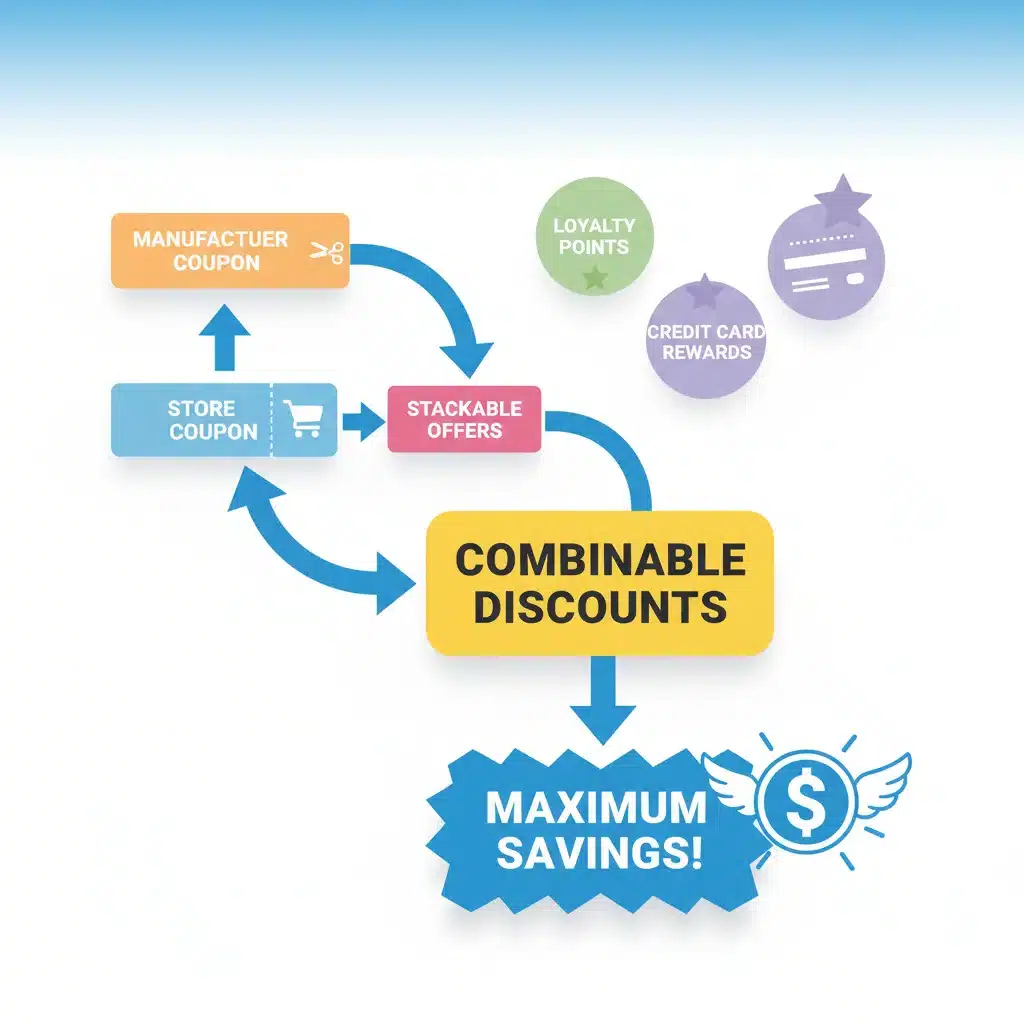
Before we dive into advanced coupon stacking strategies, let’s establish a clear understanding of what coupon stacking entails. Simply put, coupon stacking is the practice of using more than one discount on a single purchase. This could mean combining a manufacturer’s coupon with a store’s promotional code, or applying a percentage-off discount alongside a free shipping offer and loyalty points. The possibilities, while governed by retailer policies, are often more extensive than many shoppers realize.
Why Embrace Coupon Stacking in 2026?
- Significant Savings: The most obvious benefit. Instead of saving 10% with one code, you could save 30%, 40%, or even 50% by combining multiple offers.
- Enhanced Shopping Experience: The thrill of finding the perfect combination of deals adds an exciting dimension to online shopping.
- Budget Optimization: In an economy where every dollar counts, mastering coupon stacking strategies allows you to allocate your budget more effectively, freeing up funds for other necessities or luxuries.
- Access to Premium Products: Higher discounts can make previously out-of-reach premium items more affordable.
- Competitive Advantage: You’ll be shopping smarter than the average consumer, always getting the best possible price.
Many retailers have specific policies regarding coupon usage, and understanding these rules is paramount. Some stores explicitly allow stacking, while others have stricter limitations. Our goal is to guide you through these nuances, helping you identify opportunities and avoid common pitfalls.
Anúncios
The Golden Rules of Effective Coupon Stacking
Successful coupon stacking strategies are built upon a foundation of fundamental principles. Adhering to these ‘golden rules’ will significantly increase your chances of securing maximum savings and prevent frustration.
Rule 1: Always Read the Fine Print
This cannot be stressed enough. Every coupon, promo code, and loyalty program comes with terms and conditions. These details will tell you:
- Expiration Dates: Ensure your coupons are valid.
- Exclusions: Certain brands, categories, or items might be excluded from the discount.
- Minimum Purchase Requirements: Some codes only activate after a certain spending threshold.
- Stacking Policy: Crucially, does the retailer allow combining this offer with others? Look for phrases like ‘cannot be combined with other offers’ or ‘one coupon per transaction.’
Rule 2: Understand Coupon Types
Not all discounts are created equal. Distinguishing between different types of coupons is a core element of effective coupon stacking strategies:
- Manufacturer Coupons: Issued by the product manufacturer. Generally, only one manufacturer coupon can be used per item.
- Store Coupons/Promo Codes: Issued by the retailer. These can often be stacked with manufacturer coupons or other store-specific promotions.
- Shipping Discounts: Free shipping codes or reduced shipping fees.
- Loyalty Program Rewards: Points, cash back, or exclusive discounts earned through a retailer’s loyalty program.
- Credit Card Rewards/Offers: Discounts or cashback tied to specific credit card usage or offers (e.g., ‘spend $50 at X store, get $10 back’).
Rule 3: Patience and Planning are Virtues
The best deals rarely fall into your lap. Successful coupon stacking often requires a bit of research and timing. Keep an eye on upcoming sales, sign up for retailer newsletters, and track your loyalty points. Planning your purchases around promotional periods can yield significantly better results than impulse buying.
Top 5 Coupon Stacking Strategies for Online Purchases in the US (2026 Edition)
Now, let’s dive into the core of this guide: the most effective coupon stacking strategies you can employ for online shopping in the US in 2026. These strategies are designed to be practical, powerful, and adaptable to various retail environments.
Strategy 1: Manufacturer Coupon + Store Promo Code + Free Shipping
This is arguably the most classic and widely applicable coupon stacking method. Many online retailers, especially those selling groceries, health & beauty products, or general merchandise, will allow you to combine a manufacturer’s digital coupon with their own store-specific promotional code and a free shipping offer.
- How it Works: Find a product with an available manufacturer’s digital coupon (often found directly on the product page or within a ‘coupons’ section of the retailer’s website). Then, search for a general store promo code (e.g., ‘15% off your order’ or ‘$10 off $50’). Finally, look for a free shipping code or ensure your order meets the free shipping threshold.
- Example Scenario: You’re buying a new brand of shampoo. The manufacturer offers a $2 off digital coupon. The online store has a ‘20% off all beauty products’ code. Your total order is over $35, qualifying for free shipping. You apply all three, significantly reducing the final price.
- Key Tip: Always prioritize percentage-off store codes over dollar-off codes if your total purchase is high, as the percentage will yield greater savings.
Strategy 2: Loyalty Program Rewards + Store-Wide Sale + Credit Card Offer
This strategy leverages your accumulated loyalty points or rewards from a specific retailer, combines them with an existing store-wide sale, and then adds a layer of savings from your credit card. This is particularly effective at stores where you frequently shop and have built up a good rewards balance.
- How it Works: Wait for a significant store-wide sale (e.g., ‘25% off everything’). During checkout, apply your loyalty points or a reward voucher generated from your loyalty program. Finally, check if your credit card issuer has any active offers for that specific retailer (e.g., through Amex Offers, Chase Offers, or bank-specific portals) that provide cashback or a statement credit for spending a certain amount.
- Example Scenario: You have $20 in loyalty rewards at your favorite electronics store. They announce a ‘15% off all laptops’ sale. You’re buying a laptop for $800. Additionally, your credit card offers ‘$50 back on purchases over $500 at this store.’ You apply the loyalty reward, get the 15% off, and then receive a $50 statement credit from your card.
- Key Tip: Link your credit cards to loyalty programs where possible, and regularly check your credit card’s offers section.

Strategy 3: Store-Specific Category Discount + New Customer Promo + Free Shipping
This strategy is perfect for trying out new retailers or making a first-time purchase from a store you’ve been eyeing. Many online stores offer enticing discounts to new customers, which can often be combined with other promotions.
- How it Works: Identify a retailer that offers a ‘first-time customer’ discount (e.g., ‘10% off your first order’ or ‘$15 off your first $75 purchase’). Look for an additional category-specific sale running concurrently (e.g., ‘30% off all home goods’). Ensure your order qualifies for free shipping.
- Example Scenario: You want to buy a new kitchen appliance from a new online home goods store. They offer ‘20% off your first order.’ Simultaneously, there’s a ‘15% off all small kitchen appliances’ sale. Your order is over $50, qualifying for free shipping. You can often apply both the new customer discount and the category discount.
- Key Tip: Some new customer offers are tied to email sign-ups. Use a secondary email address if you want to save your primary for more targeted communications.
Strategy 4: Gift Card Purchase Discount + Regular Promo Code + Cashback Portal
This is a slightly more advanced strategy that involves a pre-purchase of a discounted gift card, then applying a regular promo code, and finally earning cashback through a shopping portal. It requires a few extra steps but can lead to significant cumulative savings.
- How it Works: First, purchase a gift card for your desired retailer at a discount. Websites like Raise.com, CardCash, or even some grocery stores occasionally sell gift cards for less than their face value (e.g., a $100 gift card for $90). Next, navigate to the retailer’s website through a cashback portal (e.g., Rakuten, TopCashback) to earn a percentage back on your purchase. At checkout, apply any valid promo codes you have, and then pay using your discounted gift card.
- Example Scenario: You plan to spend $100 at a clothing store. You buy a $100 gift card for $85. You activate a 5% cashback offer on Rakuten for that store. At checkout, you use a ‘15% off your order’ promo code. Your $100 purchase becomes $85 after the gift card discount, then $72.25 after the 15% promo, and you get 5% cashback on the $72.25.
- Key Tip: Always ensure the gift card is valid and from a reputable source. Check cashback portal rates frequently as they change.
Strategy 5: BOGO (Buy One Get One) Offer + Percentage Off Coupon + Store Rewards
This strategy is particularly effective for items you need in multiples or for stocking up. When a retailer offers a Buy One Get One (BOGO) deal, applying further discounts can lead to massive savings per item.
- How it Works: Find a BOGO deal (e.g., ‘Buy One, Get One Free’ or ‘Buy One, Get One 50% Off’). Then, look for a general percentage-off coupon that applies to your entire order. Finally, if you have any store rewards or loyalty points, apply those as well.
- Example Scenario: A shoe store has a ‘Buy One Pair, Get One 50% Off’ promotion. You find a ‘10% off your entire purchase’ coupon. You also have $10 in store rewards. You buy two pairs of shoes, one at full price ($80) and one at 50% off ($40), totaling $120. Apply the 10% off ($12 saving), bringing it to $108. Then apply your $10 rewards, making the final price $98 for two pairs of shoes.
- Key Tip: Ensure the percentage-off coupon applies to the discounted item as well, not just the full-price item.
Tools and Resources for Finding and Managing Coupons in 2026
To effectively implement these coupon stacking strategies, you’ll need the right tools and resources at your disposal. The digital landscape offers a plethora of options to help you find, organize, and apply discounts seamlessly.
Essential Coupon Finding Resources:
- Coupon Websites & Apps: Sites like RetailMeNot, Coupons.com, Slickdeals, and Honey (browser extension) aggregate thousands of coupons and promo codes. Many also have apps that make finding deals on the go easier.
- Retailer Newsletters & SMS Alerts: Sign up for your favorite stores’ email lists and text alerts. They often send exclusive discounts to subscribers.
- Browser Extensions: Extensions like Honey, Rakuten (formerly Ebates), and Capital One Shopping automatically find and apply coupon codes at checkout, and can also compare prices across different retailers.
- Cashback Portals: Websites like Rakuten, TopCashback, and Swagbucks offer a percentage of your purchase back as cash when you shop through their links. This is an excellent way to add another layer to your coupon stacking strategies.
- Social Media & Forums: Follow your favorite brands on social media, and join deal-sharing forums (like Reddit’s r/Frugal or r/Deals) where users often share newly discovered codes and stacking opportunities.
- Credit Card Portals: Regularly check your credit card issuer’s website or app for special offers and statement credits at various retailers.
Organizing Your Coupons:
With so many potential discounts, organization is key. Consider using a digital spreadsheet or a dedicated app to track:
- Coupon expiration dates.
- Retailer-specific policies.
- Loyalty point balances.
- Upcoming sales.
Common Pitfalls to Avoid in Coupon Stacking
While coupon stacking strategies offer incredible savings, there are common mistakes that can hinder your efforts. Being aware of these will help you navigate the process more smoothly.
- Ignoring Expiration Dates: A lapsed coupon is a wasted opportunity. Always double-check validity.
- Not Reading Terms & Conditions: As mentioned, this is crucial. Misinterpreting policies can lead to frustration at checkout.
- Over-Purchasing: Don’t buy something just because it’s a good deal if you don’t truly need it. The goal is to save money on necessary purchases, not to accumulate clutter.
- Forgetting Cashback Portals: It’s easy to get caught up in finding codes, but neglecting to click through a cashback portal means leaving money on the table.
- Assuming All Stores Allow Stacking: Always verify a retailer’s policy. If it’s not explicitly stated, a quick chat with customer service can clarify.
- Sharing Expired or Invalid Codes: While well-intentioned, sharing codes without verifying their validity can be unhelpful to others.
The Future of Coupon Stacking: What to Expect in 2026 and Beyond
As technology advances, so too do the methods for saving money. In 2026, we can anticipate several trends influencing coupon stacking strategies:
- AI-Powered Deal Finders: More sophisticated AI tools will emerge, capable of analyzing your shopping habits, identifying optimal stacking opportunities, and even predicting future sales.
- Personalized Offers: Retailers will continue to refine their personalization algorithms, offering highly tailored discounts that might be easier to stack with general promotions.
- Blockchain for Loyalty Programs: Some speculate that blockchain technology could make loyalty points more transparent, transferable, and potentially easier to combine across different platforms.
- Increased Digital Coupon Integration: Expect seamless integration of manufacturer and store coupons directly into online checkout processes, making stacking more intuitive.
- Subscription-Based Savings: More retailers might offer subscription models that include exclusive stacking privileges or early access to deals.
Staying informed about these technological advancements will be key to remaining at the forefront of smart shopping. The core principles of understanding coupon types and retailer policies will remain, but the tools to execute your coupon stacking strategies will only get better.
Conclusion: Become a Master of Online Savings with Coupon Stacking
Mastering coupon stacking strategies is more than just a trick; it’s a valuable financial skill that can significantly impact your budget and enhance your online shopping experience in the US. By understanding the types of discounts available, diligently reading the fine print, and strategically combining offers, you can consistently achieve savings of 30% or more.
The five strategies outlined in this guide – Manufacturer Coupon + Store Promo + Free Shipping; Loyalty Rewards + Store-Wide Sale + Credit Card Offer; Store-Specific Category Discount + New Customer Promo + Free Shipping; Gift Card Purchase Discount + Regular Promo Code + Cashback Portal; and BOGO Offer + Percentage Off Coupon + Store Rewards – provide a robust framework for maximizing your savings. Remember to utilize the wealth of online tools and resources, and always approach your shopping with patience and a plan.
In 2026, the power to save is truly in your hands. Embrace these coupon stacking strategies, transform your online shopping habits, and enjoy the substantial financial benefits that come with being a savvy, strategic consumer. Happy stacking!


