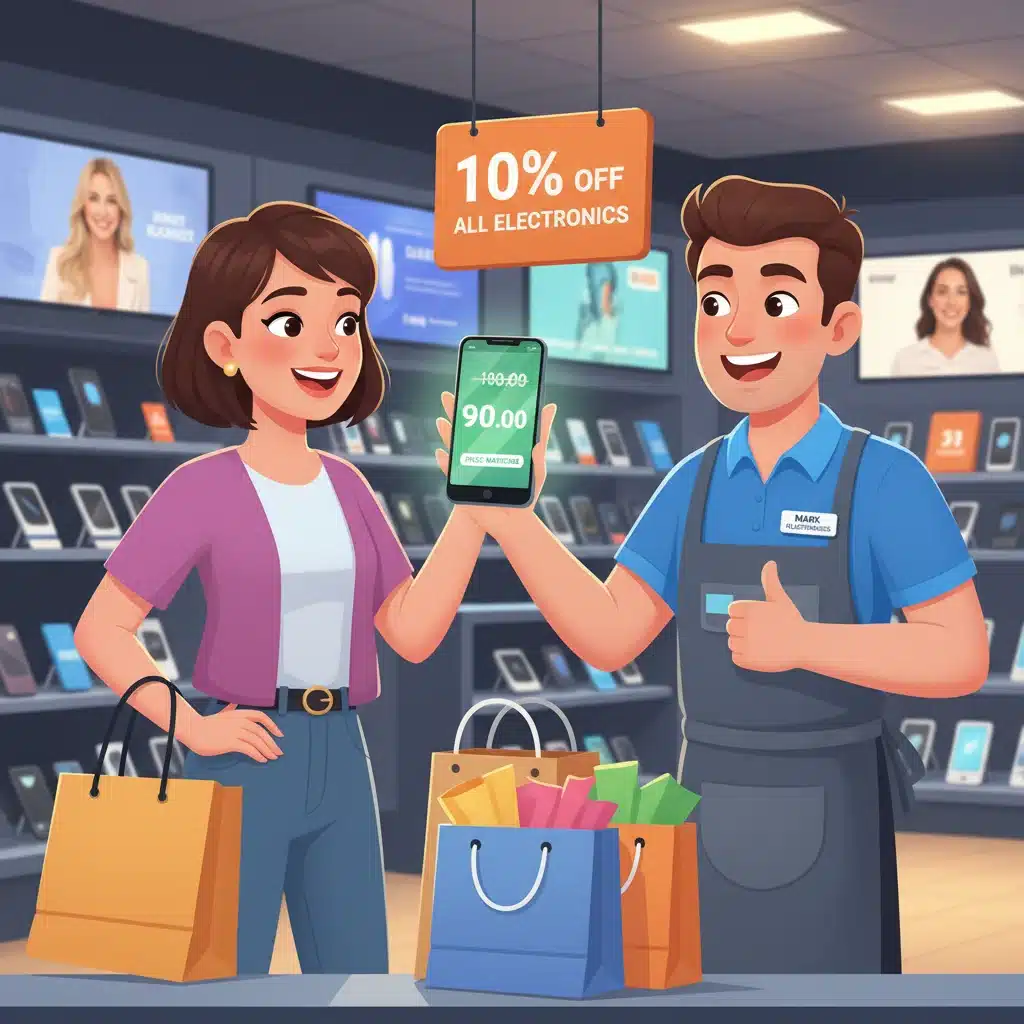
In the ever-evolving landscape of retail, savvy shoppers are always on the lookout for ways to maximize their savings. One of the most powerful, yet often underutilized, tools in a consumer’s arsenal is price matching policies. As we navigate through 2026, understanding and leveraging these policies can literally put money back into your pocket, often guaranteeing an instant 10% discount or more. This comprehensive guide will equip you with the knowledge and strategies to become a master of price matching, ensuring you never pay more than you have to.
Anúncios
The concept of price matching is simple: if you find a product at a lower price from a competitor, many retailers will match that price, and some will even beat it by a certain percentage. This practice not only benefits consumers by ensuring competitive pricing but also helps retailers retain customers who might otherwise go elsewhere. However, the devil is in the details. Each retailer has its own set of rules, exclusions, and requirements for price matching. Our goal is to demystify these rules and show you how to navigate them successfully to achieve significant savings, including that coveted 10% instant discount.
Understanding the Basics of Price Matching Policies in 2026
Before diving into specific strategies, it’s crucial to grasp the fundamental principles that govern price matching policies. While policies vary, several common threads run through most retailer guidelines. Knowing these will form the foundation of your price matching success.
Anúncios
What Qualifies for a Price Match?
Generally, for a price match to be valid, the products must be identical. This means the same brand, model number, color, size, and packaging. Any slight variation can be a reason for a retailer to deny a price match. Furthermore, the item must be in stock at both the competitor’s store (or website) and the store where you are requesting the match. Limited-time offers, clearance items, refurbished products, and bundled deals are often excluded.
Eligible Competitors
Retailers typically have a list of approved competitors whose prices they will match. This often includes major brick-and-mortar stores and their online counterparts. Online-only retailers might be included, but this is less common and highly dependent on the store’s specific policy. Always check if the competitor you’ve found a lower price from is on the retailer’s approved list.
Proof of Lower Price
You will almost always need to provide verifiable proof of the lower price. This usually means a current advertisement, a link to the competitor’s website, or a photograph of an in-store price tag. The ad or website must clearly show the item, its price, and the date. Screenshots are generally accepted, but some retailers might require the associate to verify the price on their own device or computer.
Time Limits and Price Adjustments
Many retailers offer price adjustments, meaning if an item you’ve purchased goes on sale at their store or a competitor’s within a certain timeframe (e.g., 7-14 days), you can get the difference back. This is distinct from a live price match at the time of purchase but is an equally valuable saving strategy. Always keep your receipts!
Top Retailers with Advantageous Price Matching Policies in 2026
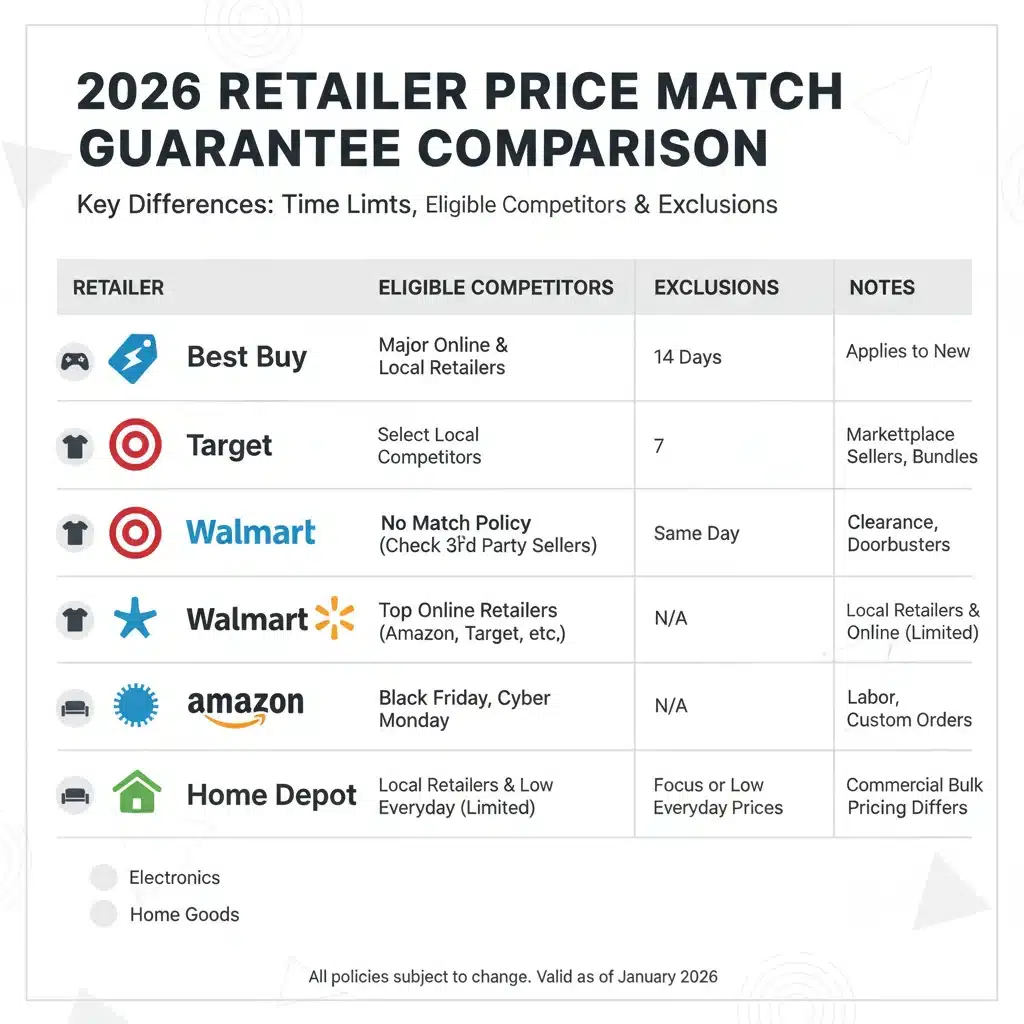
To truly master price matching, you need to know which retailers offer the most generous price matching policies. While specific policies can change, certain stores consistently stand out. Here’s a look at some of the key players in 2026:
Best Buy
Best Buy is renowned for its robust price matching policy, particularly for electronics. They typically match local retail competitors and major online retailers like Amazon, Dell, HP, and Crutchfield. Key points to remember:
- Eligibility: Identical items, in stock.
- Competitors: Local brick-and-mortar competitors and major online retailers.
- Exclusions: Clearance, open-box, refurbished, pre-owned, or damaged items; special daily or hourly sales; and prices from marketplace vendors.
- Strategy: Always check Amazon’s price before heading to Best Buy. Their policy is usually quite straightforward, making it easier to secure a match.
Target
Target offers price matching on a wide range of products, including groceries, electronics, and home goods. Their policy is quite comprehensive:
- Eligibility: Identical items, in stock.
- Competitors: Target.com, select online competitors (Amazon, Walmart, Best Buy, etc.), and local brick-and-mortar competitors.
- Exclusions: Prices from third-party marketplace sellers, clearance, liquidation sales, and specific holiday event prices.
- Strategy: Target’s policy often includes their own online prices, so if an item is cheaper on Target.com than in-store, you can request a match.
Walmart
Walmart’s price matching policy has seen various iterations over the years. Currently, it’s more focused on matching their own online prices rather than external competitors in all cases:
- Eligibility: Identical items sold by Walmart.com.
- Competitors: Primarily Walmart.com’s own prices. Some stores might match local competitors at manager discretion, but this is not a universal policy.
- Exclusions: Third-party marketplace sellers on Walmart.com, clearance, rollback, or special event pricing.
- Strategy: Always check Walmart.com’s price before going to a physical Walmart store. If the online price is lower, you can usually get a match.
Home Depot / Lowe’s
These home improvement giants generally have strong price matching policies, often offering an additional percentage off the matched price, which is where the 10% instant discount comes into play for some items.
- Eligibility: Identical items, in stock at both locations.
- Competitors: Local retail competitors.
- Exclusions: Special orders, services, custom products, volume discounts, and items sold by third-party marketplace vendors.
- Strategy: For major purchases like appliances or tools, always compare prices between Home Depot and Lowe’s. They often try to undercut each other, and you might get an extra 10% off the matched price.
Amazon (Less Common for Traditional Matching)
While Amazon is often the benchmark for lower prices, they typically do not price match other retailers. However, they do offer price adjustments if an item you purchased from them drops in price within a short window. The strategy here is to use Amazon’s low prices as the benchmark for price matching at other stores.
The Instant 10% Discount Strategy: How to Leverage Policies for Maximum Savings
Now for the exciting part: how to consistently achieve an instant 10% discount through strategic price matching. This isn’t a universal guarantee for every item at every store, but it’s a very achievable goal for many purchases, especially in certain categories.
Step 1: Identify Retailers with a ‘Beat the Price’ Policy
The key to the 10% instant discount lies with retailers who don’t just match a competitor’s price but promise to beat it by a certain percentage. Home Depot and Lowe’s are prime examples, often stating they will beat a competitor’s price by 10%. Some independent electronics stores or specialty retailers might also offer similar incentives.
Step 2: Find a Lower Price from an Eligible Competitor
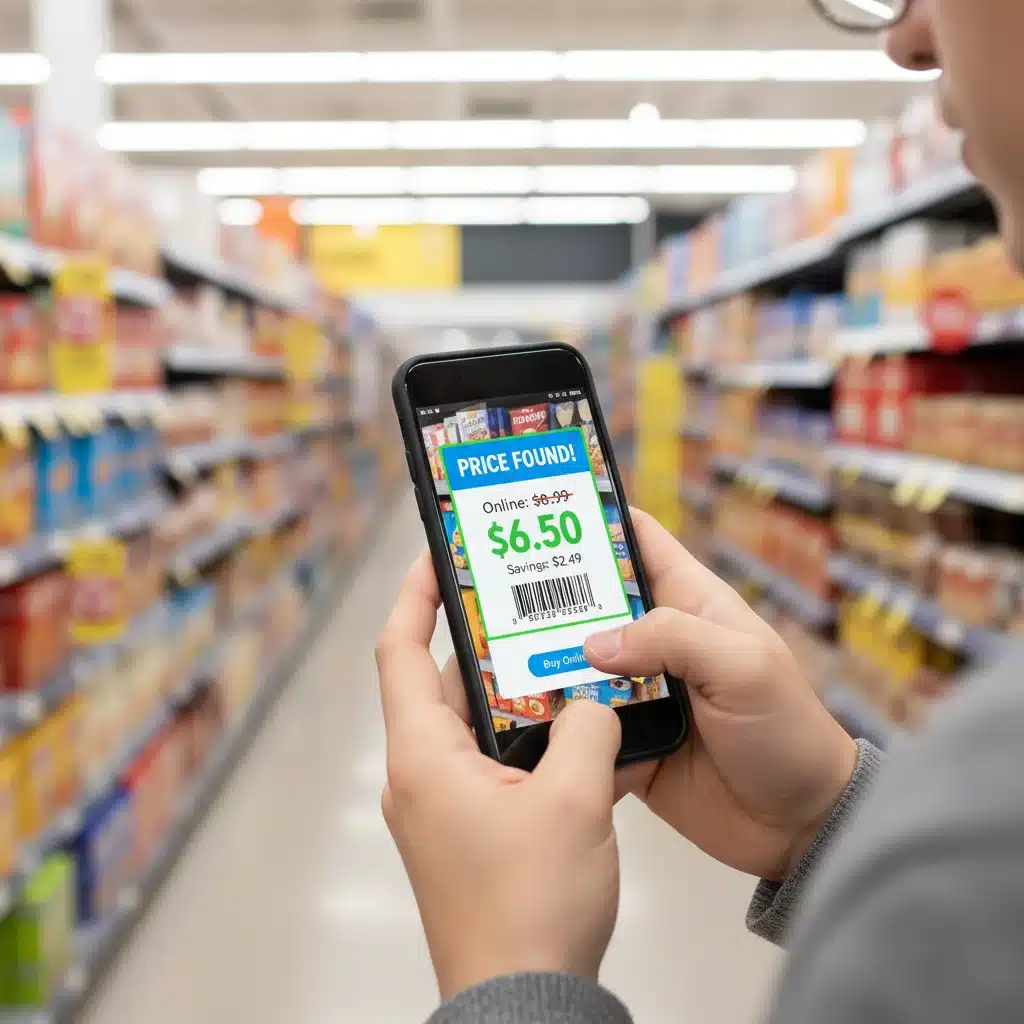
This is where your research skills come into play. Use price comparison apps and websites (like Google Shopping, PriceGrabber, or dedicated store apps) to scout for the lowest price on the identical item you wish to purchase. Ensure the competitor is on your target retailer’s approved list and that the item is in stock.
Step 3: Verify the Item is Identical and In-Stock
Double-check model numbers, UPCs, colors, and any specific features. The item must be exactly the same. Confirm it’s in stock at both the competitor (for the lower price) and the store where you intend to make your purchase. Out-of-stock items will almost always be denied a price match.
Step 4: Present Your Evidence Clearly and Politely
When you’re ready to make your purchase, approach a customer service representative or a sales associate. Clearly state that you’d like to price match an item. Have your evidence ready – a printed ad, a live website link on your phone, or a clear screenshot. Be polite and confident. Remember, the associate is more likely to help you if you are respectful.
Step 5: Confirm the 10% Discount (If Applicable)
If you’re at a retailer known for beating prices by 10% (like Home Depot or Lowe’s), explicitly mention this. For example, you might say, "I found this item at [Competitor Name] for [Lower Price], and I understand you have a policy to beat competitors’ prices by 10%." This prompts the associate to apply the additional discount.
Example Scenario for a 10% Discount:
You need a new power drill. You find it at Lowe’s for $100. A quick search reveals that Home Depot has the identical drill for $90. You go to Lowe’s, show them the Home Depot ad. Lowe’s, with its ‘beat by 10%’ policy, will not only match the $90 price but will take an additional 10% off that matched price, making your final cost $81. That’s a significant saving purely by leveraging price matching policies!
Advanced Strategies and Common Pitfalls to Avoid
Beyond the basics, there are advanced tactics and common mistakes that can make or break your price matching attempts.
Advanced Strategies:
- Use Price Tracking Apps: Apps like Honey, CamelCamelCamel (for Amazon), or specific store apps can track price drops and alert you, making it easier to find lower prices for price matching or adjustments.
- Check Holiday Sales Early: Retailers often exclude Black Friday or Cyber Monday prices from their price match policies. However, some will match prices leading up to these events or shortly after. Always read the fine print.
- Leverage Online vs. In-Store: Many retailers will match their own online prices in-store, even if the online price is lower. This is a simple win if you prefer shopping in person.
- Know Your Rights (and the Policy): Print out or save a digital copy of the retailer’s price matching policy. If an associate is unfamiliar or misinterprets the policy, you can politely refer them to the official guidelines.
- Combine with Coupons/Rewards: In some rare instances, retailers might allow you to combine a price match with a coupon or loyalty rewards. This is highly dependent on the specific store and coupon terms, but it’s always worth asking.
Common Pitfalls to Avoid:
- Expired Ads/Prices: Ensure the lower price you’re presenting is current and not expired.
- Out-of-Stock Items: A lower price on an item that’s out of stock at the competitor is usually not eligible for a price match.
- Third-Party Sellers: Prices from third-party marketplace sellers (e.g., on Amazon, Walmart.com, eBay) are almost never matched by traditional retailers. Always ensure the seller is the actual retailer or an approved first-party vendor.
- Misunderstanding ‘Identical’: "Similar" is not "identical." Even a slight difference in model number or features can invalidate a price match.
- Lack of Documentation: Always have clear, verifiable proof of the lower price. "I saw it cheaper online" won’t cut it.
- Aggressive Behavior: Being rude or demanding will rarely get you what you want. A calm, polite approach is always best.
The Future of Price Matching: Trends for 2026 and Beyond
As retail continues to evolve, so too do price matching policies. Several trends are shaping how consumers can expect to save in the coming years:
Increased Automation and Digital Verification
More retailers are integrating digital tools that allow associates to quickly verify competitor prices online. Some are even experimenting with AI-driven price matching at checkout, automatically applying discounts when a lower price is detected.
Focus on Online Competitors
With the continued dominance of e-commerce, expect retailers to increasingly focus their price matching efforts on major online players. This means less emphasis on matching obscure local brick-and-mortar stores and more on big names like Amazon, Best Buy, and Target’s own online platforms.
Dynamic Pricing Challenges
The rise of dynamic pricing (where prices change frequently based on demand, inventory, and other factors) presents both opportunities and challenges. While it can lead to more frequent price drops, it also makes it harder to "catch" a price at the right moment for a match.
Subscription-Based Price Protection
Some retailers or third-party services might offer subscription models that automatically track your purchases and apply for price adjustments on your behalf. This could be a game-changer for hands-off savings.
Making Price Matching a Habit
The most effective way to leverage price matching policies is to make it a regular part of your shopping routine. It might seem like extra effort at first, but the savings quickly add up. Consider these points:
- Before every major purchase: Especially for electronics, appliances, and large home goods, always dedicate a few minutes to checking competitor prices.
- Use browser extensions: Install extensions that automatically search for lower prices or coupon codes when you’re shopping online.
- Stay informed: Retailer policies can change. Periodically check the price matching guidelines of your favorite stores.
- Don’t be afraid to ask: The worst they can say is no. Many times, you’ll be pleasantly surprised by the savings you achieve.
By integrating these practices, you transform from a passive consumer into an active participant in securing the best possible deals. The instant 10% discount is not a myth; it’s a tangible reward for those who understand and apply the principles of effective price matching.
Conclusion: Your Path to Smarter Shopping and Instant Savings
In conclusion, mastering price matching policies in 2026 is an indispensable skill for any savvy shopper. By understanding the nuances of different retailer guidelines, knowing which stores offer the best deals, and employing strategic approaches, you can consistently unlock significant savings, including that highly sought-after instant 10% discount. Remember to always verify eligibility, provide clear proof, and approach the process with politeness and confidence.
The retail world is designed for competition, and price matching is your way of ensuring you benefit directly from that competition. Don’t leave money on the table. Start applying these strategies today and transform your shopping experience into one of smart savings and instant gratification. Happy shopping, and may your discounts be plentiful!